
Part 1 Al-Andalous, Haroun al-Rachid and Cordoba
When we talk about perfume, everyone thinks about Paris as the center of perfumery, and we forget about the whole world of perfume history. I would like to remind everyone the way perfumery entered Europe and the role of Spain in the perfume heritage. It is not an accident that Spain is taking the lead today in the evolution of perfumery.
Spain has an important perfume heritage. For the first episode of this new series, I invite you to follow me into the Spanish Middle Ages.
The initial invasion of the Iberian Peninsula was led by the Umayyad general Tariq ibn Ziyad. In 711 CE, Muslims swiftly conquered most of the region, establishing control over a large part of what would become Al-Andalus.
By the time Haroun al-Rashid began his rule, the Umayyad dynasty had already been overthrown by the Abbasids in a revolution known as the Abbasid Revolution in 750 CE. After this, those Umayyads who escape established their own rule in Spain, with Córdoba as the capital, thus continuing the Islamic presence in the region.
Haroun al-Rashid was the fifth caliph of the Abbasid dynasty, ruling from 786 to 809 CE. He is often remembered as one of the most famous and well-regarded caliphs in Islamic history. His reign marked a period of cultural, economic, and scientific flourishing within the Islamic Golden Age. Under his rule, Bagdad became a center of trade and commerce. The capital city was known for its architectural wonders and was a hub for scholars and traders from different cultures and backgrounds.
During and after Haroun al-Rashid’s reign, Córdoba emerged as a significant center of Islamic culture and learning. The city became renowned for its advancements in various fields, including medicine, philosophy, and poetry. It was marked by architectural achievements, such as the Great Mosque of Córdoba.
Al-Rashid was a patron of the arts and sciences. He encouraged literature, philosophy, and scientific endeavors, which helped to foster a rich cultural environment. The famed collection of stories known as « One Thousand and One Nights » (or « Arabian Nights ») was completed during his time, though it is a compilation of tales from various sources.
The Abbasid Empire, under Haroun al-Rashid, thrived economically, which fostered trade relations across the Mediterranean. This period saw extensive trade in luxury items, including perfumes and essential oils. Arab merchants were known for their high-quality fragrances, which would find their way into Spain through the Perfume Roads.
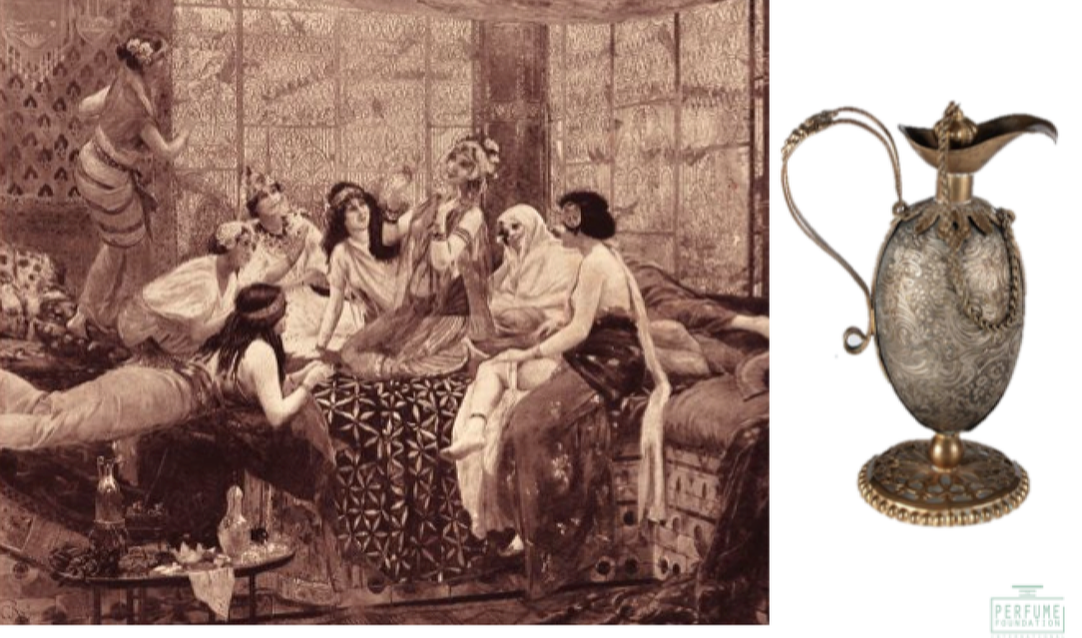
Spain became a center for cultural and scientific exchange. The Arabs brought with them advanced knowledge of alchemy and distillation, which was crucial for the development of perfumes. They introduced new ingredients and techniques, influencing the European approach to perfumery. They brought with them the art of perfume and the science of perfumery, the culture of flowers and raw material for perfumery. This period saw advancements in the methods of extracting and blending fragrances.
The city of Córdoba, during the height of Al-Andalus, was a major center for learning and culture, including the art of perfumery. The influx of goods, including perfumes from the Middle East, brought new scents and the art of fragrance creation to Spain.
While Haroun al-Rashid may not have traveled to Spain himself, his reign contributed to the cultural and economic exchanges that facilitated the introduction and evolution of perfumery in the region, influencing both local practices and later European traditions.
Perfumes became a status symbol within Spanish and later European courts, much as they had been in the Islamic world. The use of elaborate fragrances reflected wealth and sophistication, and this cultural aspect can trace some of its roots back to the interactions during Haroun al-Rashid’s reign.
The Islamic presence in the Iberian Peninsula lasted from 711 CE until 1492 CE, a period of nearly 800 years significantly influencing the culture, architecture, language and science of the region.
Check our next Episode: Spain a Forgotten Legacy Part 2
In the meantime if you are passionate by perfume, follow Creezy Courtoy’s World Perfume History Course