BEAUTIFUL POMANDERS AND THEIR RECIPES

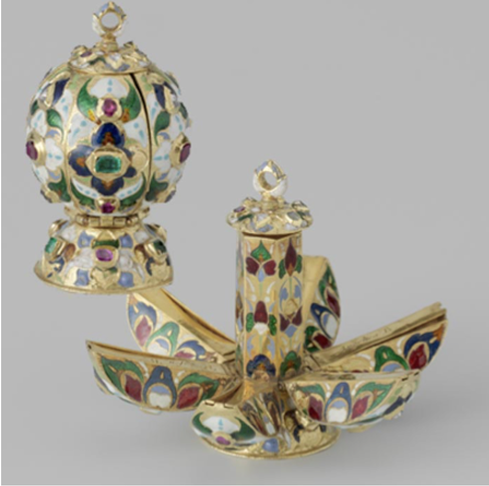
Pomander enameled gold in the shape of a pomegranate and adorned with ruby, emerald and diamond. Circa 1600 - 1625 © Rijksmuseum
Pomander enameled gold in the shape of a pomegranate and adorned with ruby, emerald and diamond. Circa 1600 – 1625 © Rijksmuseum

Perfume has always had a sacred meaning connecting man with the divine, but did you know that it had other more « therapeutic » roles such as protecting or even preserving the good health of the body?
The oldest knew it and they used essences, resins in various forms for this action. Fumigations, anointing, and also accessories for carrying perfume were used as early as ancient Egypt. This way of proceeding was then taken up again during ancient Rome and then came to Europe through the Crusades.
This accessory diffused the scent of aromatics, animal raw materials and various resins thanks to the body heat. It is said then that he helped protect himself from the Black Death and other miasmas of the time. Far from being a tool or means of seduction, this perfume had above all a medicinal function above all.
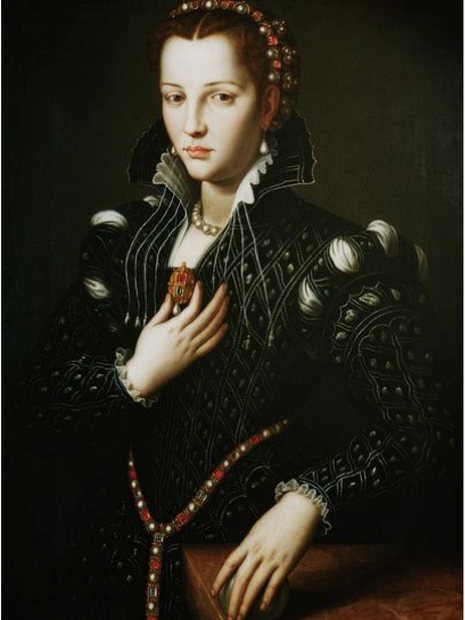
Agnolo Bronzino (1503-1572), Portrait of Lucrezia de Medici. Oil on panel, circa 1560 © North Carolina Museum of Art
Agnolo Bronzino (1503–1572), Portrait of Lucrezia de Medici. Oil on panel, circa 1560 © North Carolina Museum of Art

It was most often of an almost solid pasty texture. Its powerful and purifying fragrance emanated from an accessory called sweet apple.
This object has evolved greatly over the course of history to be worn like a jewel on the belt or around the neck. The Renaissance saw sweet apples as a fashion accessory with multiple functions, including those of covering bad body odor and protecting against epidemics decimating the population. It must be remembered that bodily hygiene was understood as something almost erotic by the Church. The sweet apple was then very practical to use and this accessory was declined like a real jewel even demonstrating a level of richness by the object and by the raw materials used because these were expensive.
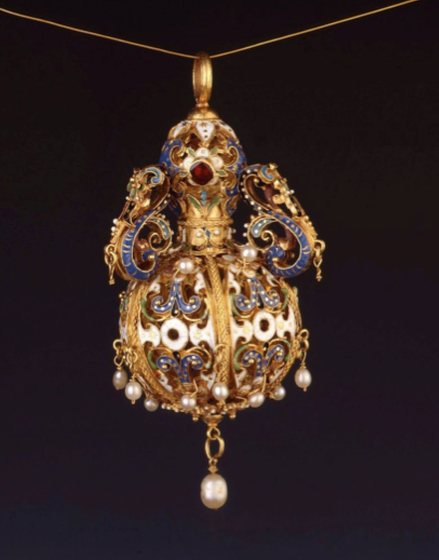
German pomander in gold, enamel and precious stones, early 17th century. This jewel measures 8 cm in height and 4 cm in diameter. © Burghley Collections

What is a sweet apple and how does it work?
Sweet apples, « pommanders » or « pomanders » are either openwork or made up of airtight « quarters ». These objects are almost exclusively precious jewels. Common people and poor people cannot afford these rare and expensive perfumes. Pomanders are usually spherical in shape and open in two parts and then into several quarters, like an orange. In each of these quarters are placed the herbs. In contact with the heat of the body, the aromatics exhaled their perfumes, delicious perfumes offered to God « per fumum ». Perhaps this original oblation helped to obtain a divine favor: that of living a long life or curing an illness in addition to emanating powerfully purifying and protective aromatic scents. Medieval sweet apples were continually worn by their owner. As a necklace, a ring or held at the end of a velvet ribbon or a precious metal chain, they accompanied the body and remained as close as possible to it.
 
What raw materials for perfume were then used?
These objects allow you to carry the scent of musk, ambergris or civet with you (materials all secreted by wild animals with a … pronounced smell)
The Song of Songs also regularly refers to spices. In its different versions (Greek, Latin or Hebrew), it always ends by evoking « the mountain of spices ». The aromatics therefore legitimately find their place in the culture of the Middle Ages. They are the luxurious ingredients warmly recommended by the Church to guard against epidemics and especially the Black Death.
In 1174, the ancestor of perfume diffusers arrived in Europe. On this date, Baudoin IV (1161-1185), King of Jerusalem, offered Emperor Frederick Barbarossa (1122 – 1190) several golden apples (precious sweet apples) filled with musk. Chronologically, musk and amber are the most popular scents. Nevertheless, from the middle of the 14th century, the Paris medical faculty added no less than 29 odorous substances suitable for taking place in these cases. Thus make their appearance nutmeg, aloe wood, ginger, cloves, cinnamon, camphor, sandalwood or cinnamon. These herbs come from the Eastern Perfume  Roads crossing countries as far as they are fascinating.

Recipe for making pomander included in The Treasury of Commodious Conceits, and Hidden Secrets by John Partridge (London, 1586)

« Benzoin resin, calamus, labdanum, and storax balm were ground into a powder, dissolved in rose water, and placed in a saucepan over a fire to cook together. The cooked mixture was then removed from the heat, rolled into an apple shape and coated with a powdered mixture of cinnamon, soft sanders and cloves. After that, a concoction was made from three grains each of ambergris, deer musk and civet musk. Ambergris was dissolved first, and deer and civet musk were mixed later. The « apple » ball was rolled through the musk concoction to blend into these ingredients, then kneaded to combine and molded into an apple shape. »

Nostradamus Recipe
Michel de Nostredame had a similar method and formula but a rather different procedure. The « rose tablets » were made by soaking a pound of roses without the flower heads in deer musk water overnight. The water was then carefully wrung out and the roses crushed with seven ounces of benzoin, a quarter of ambergris and another of civet musk. This mixture was made into tablets, which were each sandwiched between rose petals and dried in a cool, dark place.  To form the final pomander, two ounces of the purest labdanum, one ounce each of styrax and benzoin resin, half an ounce of rose tablets, one ounce of violet powder, and half a dram each of ambergris and musk were ground into powder and kneaded with rose water from the manufacture of rose tablets. This produced « an aromatic ball of the most sublime and long-lasting scent that could be made anywhere in the world » it seems.

Pomanders - Creezy Courtoy
Simple and usual pomander

If you were to create a pomander today with existing raw materials, what would the formula be? 
Become a natural perfumer and discover how to formulate natural fragrances; discover the program and register quickly before November 8th. The French Natural perfumery program opens its doors for 8 exciting weeks!
And if you want to learn more about the history of pomanders don’t miss Creezy Courtoy’s World Perfume History MasterClass starting on December 6. 

Raw Material Methods Extraction and Olfaction Training

Hunting for strange and unusual new materials

THE POWER OF THE RAW MATERIAL AND THE ART OF REDISCOVERING THE ORIGINS OF NATURAL PERFUMERY.
A sentimental introduction to the extraction of raw materials
by Andrej BABICKY,

IPF Chairman Italy,
Raw Material Methods Extraction and Olfaction Training Expert

There are plants from which we are not surprised that essential oil or an absolute is extracted. Their use is understandable due to their aromatic properties: think of a rose, jasmine, basil, etc. They are « obvious » raw materials. They have now become fundamental in a perfumer’s palette. But there are also those which we will not immediately think could be used. I love these, curious and sometimes even strange essences.

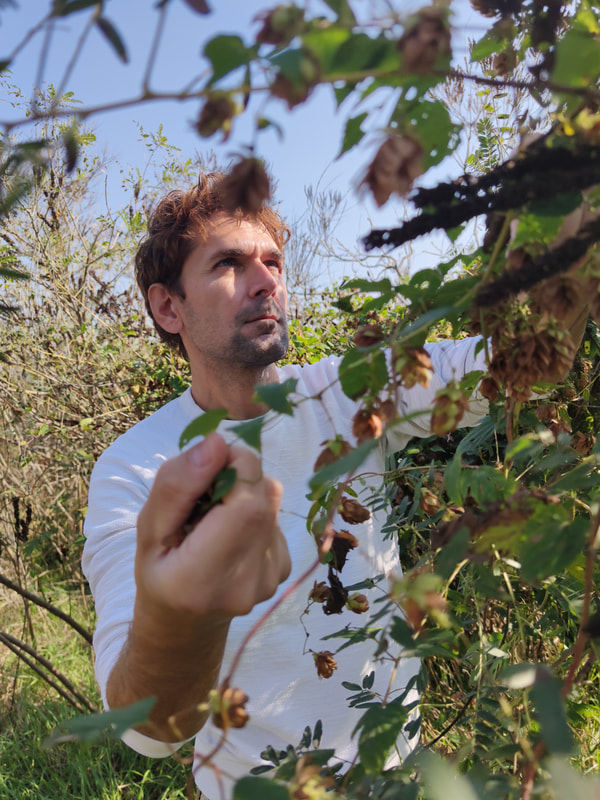
Pr. Andrej Babicky
Pr. Andrej Babicky

I live in an area of Italy, Piedmont, in a small town surrounded by woods and fields.
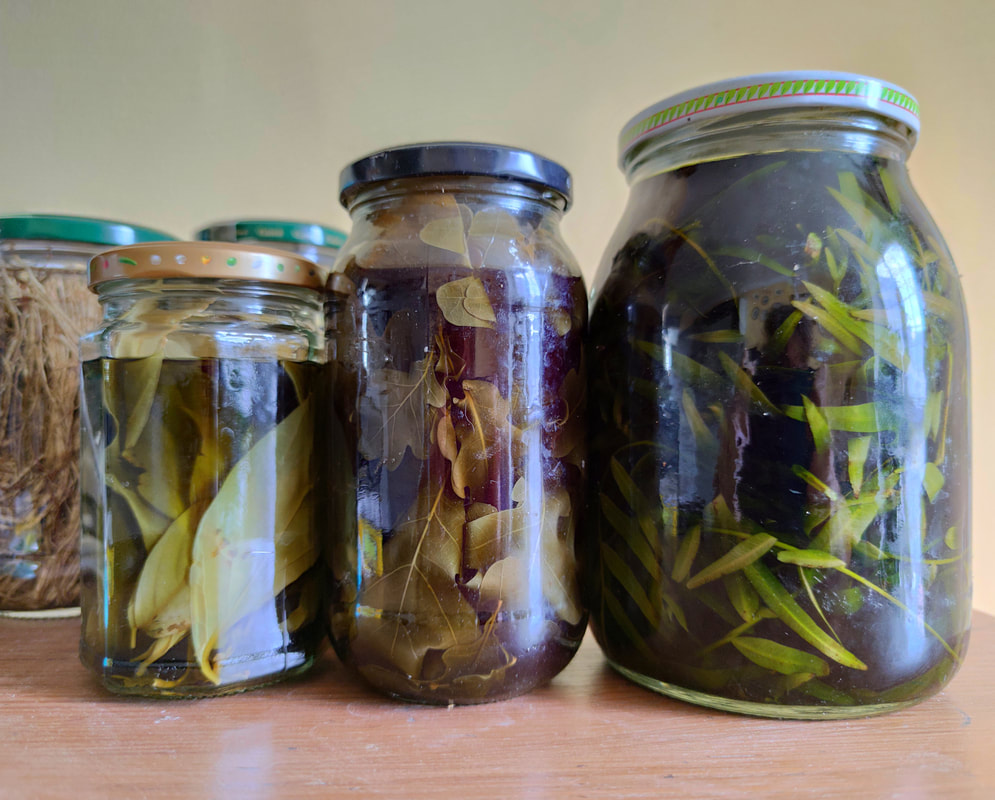
In the garden, I cultivate ornamental plants for the pure pleasure of their flowers or their leaves but also other, perfumed, to extract their fragrance: different varieties of roses, aromatic herbs, daffodils, hyacinths, chrysanthemums, lilacs, tetradenias and much more. I love the explosion of colours and scents of the garden in spring, but I also love the quiet of autumn. The garden is slowly falling asleep. These are the moments that lead me to look beyond the hedge, to return to take long walks in a bare landscape immersed in the usual fog of the area. These are moments of calm and intentional solitude in which I can contemplate the passing of the seasons. These are also times in which I start looking for seasonal fruits and berries, or new plants to extract; something different, new to fill the tincture jars with.

Not all the extractions I do, I then use in perfumes. Some remain closed in their containers for some time, even years, before I can find the right use. But I often extract for the sheer pleasure of experimenting and exploring.

Raw Material Methods Extraction MasterClass

Autumn is the season of mushrooms that can be used to expand our palette of essences.
Think of their damp mossy smell, of undergrowth, of fallen leaves wet from the rain. Think about how nicely these nuances can expand those of the woods and barks. Different varieties are used in cooking or cosmetics that we can use too. Porcini, chanterelles, field mushrooms, honey mushrooms and many more. Each with their olfactory peculiarity. 

chanterelles

I discovered chanterelles by chance. Their orange colour stands out on the ground, single or in clusters camouflaged among the fallen leaves.
The characteristic that struck me is their taste and aroma that somehow recalls that of apricot with wild nuances. Mushrooms can be dried and then used in tinctures.
To my surprise, I found some woody mushrooms. Doing some research, I found out that it is the Ganoderma species. They are known for their medicinal properties. Some are easily recognizable and rather easy to find. They are lignicolous, annual or multi-annual fungi of brown, ocher, or reddish colour with a lighter underside. They are parasites and saprophytes. They can be found on both deciduous and coniferous trees.
Their scent immediately refers to that of mushrooms in general but once dried it takes on a darker, richer woody profile. Sliced when still fresh and left to dry in the air for a few days, they can be used in tinctures.

How could we forget about the truffles? They constitute a precious and sought-after food essence. Their scent, so penetrating and distinctive, develops only after ripening and to attract wild animals to spread the spores and perpetuate the species.
The truffles were already appreciated in ancient times. Aphrodisiac properties were ascribed to them. For some, their aroma, during the period of the Middle Ages and the Renaissance, contributed to the ecstatic effect on man.
Although relatively rare and expensive, truffles can add a distinctive earthy, musky, moist, somewhat nutty and dark chocolatey undertone. A small amount is enough to give a new dimension to a fragrance.
The leaves, which in this period are tinged with bright colours, can represent an interesting raw material. Have you ever rubbed the nearly dry leaves of walnut or cherry in your hands? Have you ever smelled it? While walnut leaves may be difficult to work into a final composition due to their ability to dye, cherry leaves have a delicately fruity hay scent. I especially love the oak ones that I extract both in spring and autumn. The young ones have a bitter, warm, lively and intensely green scent while those at the end of their life cycle give me the sensation of wood warmed by the sun, the scent is more dense, mysterious, rich with earthy nuances.

During one of the walks, I had by chance browsed among the shrubs of Amorpha fruticosa in search of mushrooms.
I still remember today the pungent, resinous, warm, and intense smell that remained on my hands while I was trying to make my way through the shrubs. I did not immediately connect the smell to that of the plant to which I had not paid much attention before. I was very surprised when, by exclusion, I was able to link the odour to this species and after some research on toxicity I started the first extraction experiments. It is a North American plant that grows spontaneously around the house. In the past, it was used to produce dye for fabrics and ornamental purposes. With time and abandonment of cultivation, it became wild and invaded roadsides, riverbanks, and the fields. It is one of the most invasive species in Europe. Its seeds have a curious olfactory profile: herbaceous, aromatic, vaguely urinous with hints of spicy accents that remind me of the seeds of some Apiaceae. The leaves also have a characteristic scent, strongly aromatic, resinous, warm and different from that of the seeds. The same plant offers two interesting and unusual raw materials.

Among my favourite fruits, not so much for the taste, but for the smell, is the quince.
My grandmother used to put some in the closet. Their scent mixed with that of wood, bunches of lavender and fabrics, creating an intense and rich aroma. The fruit, cut into thin slices and dried, creates an acidulous, unusual, pleasantly juicy and liqueur-like tincture with green, herbaceous and vaguely floral nuances.
 
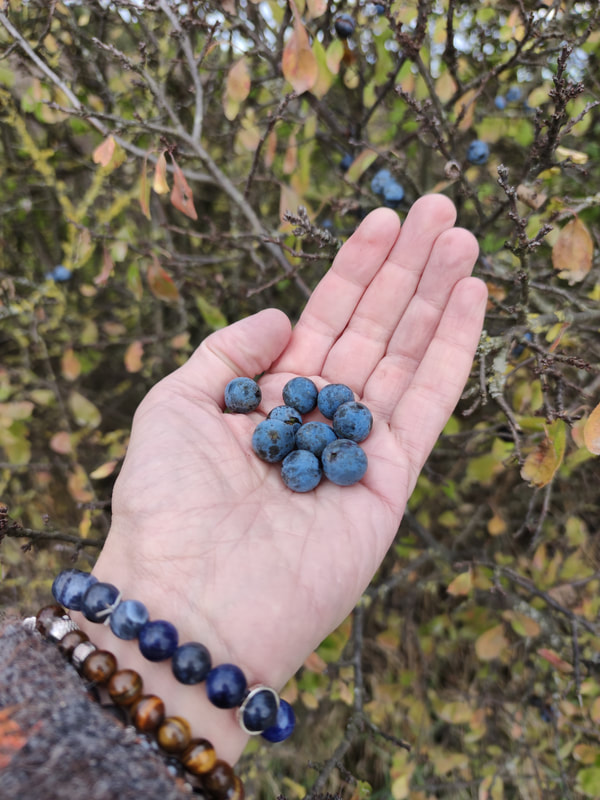
Mahonia plants are also covered in dark blueberries this season. Their sour taste is reminiscent of that of unripe grapes. The fruits, berries with a floury consistency, can be easily dried. I use them to create a sour-scented, wild berry tincture that adds a pleasant fruity hue to the rose.

An unusual natural perfumery raw material
Hunting for strange and unusual new materials

Think of what nature offers around you in this period: pumpkins, berries, roots, tree bark covered with moss, lichen, mushrooms, seeds, pine cones covered with resin, leaves and flowers.
Sniff them, taste them, rub them in your hands. Do you smell them?
Can you imagine it in a fragrance? Sometimes you just need to look around.
Autumn is a magical season for this too: nature is preparing to conclude a cycle, to fall asleep until spring, but for us, it may be the right time to awaken our sense of smell. Let us be guided by the nose to discover new smells around us.

Follow a Natural Olfaction Training Course or a Raw Material Extraction Method Course with Pr. Andrej Babicky

New Luxury Code, The Value of Respect

The New Luxury Code

Make no Mistake; Selling to Consumers Today is as Difficult as it Has Ever Been, and it Doesn’t Appear it Will be Easing up Anytime Soon. 
With competition so strong from large brick-and-mortar retailers as well as rapidly growing online retail activity, continued success for high value retailers will increasingly depend following these three basic value-marketing fundamentals:

  1. Develop a totally value-based business to differentiate you from the competition and persuade growing numbers of high value customers there is greater value in your products than that of other competitive products. 
  2. Target consumers who demand more value, will pay more for receiving value, and if satisfied will repurchase again and again.
  3. Follow the New Luxury Code, the most important value-marketing fundamental. 

The New Luxury Code is about recognizing and acknowledging the value of ourselves and the world surrounding us. 
It is a continuing reminder of what is important to respect and why; and because of its importance, the New Luxury Code should be part of the value proposition of everyone involved in the high value essential oil distribution chain community from seeds to consumers.

How Can High Value Retailers Express Their Respect for Consumers?

  1. Understand what represents value to them and then provide that value. Consumers want natural products, free from GMO and synthetic chemicals. They also want to know more about who produced their products and whether they were produced sustainably.
  2. Always treat customers courteously and professionally, even if you disagree with them. Angry customers tell more of their friends about their negative experiences, as opposed to loyal customers sharing positive stories.
  3. Establish yourself as an expert in your community. Education empowers retailers by differentiating them from large, powerful competitors, so educate yourself and then educate the community or communities you serve. 

Make sure your customers and the rest of the high value essential oil distribution chain community get the respect they deserve by following the New Luxury Code.
 
Terry Johnson will be teaching marketing starting February 2022

Contact Terry