
Poinsettias and Christmas
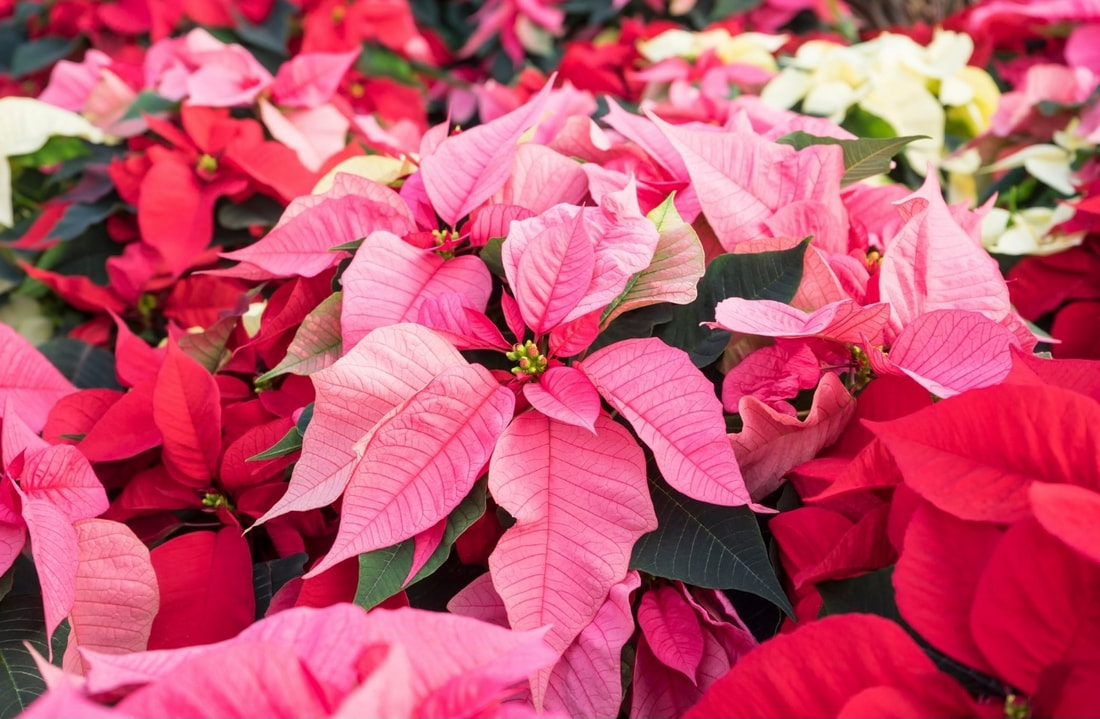
A Symbol of Life and New Beginnings for Each Year
The origins and history of Poinsettias ( Euphorbia pulcherrima) take us to the Aztec
Civilization, where this flower was called cuetlax ōchitl, meaning « flower that grows in residues or soil”. This plant only grew in Winter from the lower altitudes in Mexico, in what is now Taxco, Cuernavaca. As with the higher altitudes of what is now Mexico City, previously called Tenochtitlan, it was not possible to grow this plant, and just got imported in that time from these low altitude areas.
These flowers were used by the Aztecs in ceremonial sites and temples. As the Spaniards were trying to vanish any pagan rituals and beliefs from the Aztecs, they used the Poinsettias or cuetlaxõchitl flowers for the Celebration of Christmas. The Spaniards took the poinsettias as a symbol to get rid of the original pagan traditions of the Aztecs and replace them with friars of the Franciscan Christian religious order in Mexico included the plants in their Christmas celebrations. The star-shaped leaf pattern is said to symbolize the Star of Bethlehem, the red colour represents the blood shed during the sacrifice of Jesus’ crucifixion, and the white leaves represent the purity of Jesus.
Today, Poinsettia (Euphorbia pulcherrima) is known in Mexico and Guatemala as
“flor de nochebuena” or simply “nochebuena”, meaning « Christmas Eve flower”. In other countries, like Spain, this plant is called “flor de pascua ”, meaning “Pascal flower” (Spanish people say “Pascua” to Christmas and “Pascua de Resurreción” to Passover or Easter). In Chile and Peru, this plant is known as “The Crown of the Andes”.
Poinsettia is a commercially important flowering plant species of the diverse spurge family Euphorbiaceae. Indigenous to Mexico and Central America, the poinsettia was first described by Europeans in 1834. It is particularly well known for its red and green foliage and is widely used in Christmas floral displays. The flower was originally called either “Mexican flame flower” or “painted leaf” by people in United States, then, in 1836, the plant was named taxonomy after Joel Roberts Poinsett, the first United States minister to Mexico, who also was a botanist, spoke many languages and was credited with introducing the plant to the USA in the 1820s.

From that time and during the 20th century, production and propagation methods have
improved, but cutting large stems short and focusing on growing coloured leaves wider.
More than 100 cultivars have been produced in Mexico, US and Europe including white, cream, yellow, peach, pink, purple, and marbled. Red poinsettias still account for more than 70% of sales.
This plant brings all the leafy flower and colour only in Winter as a good promise to open a New Year. Nowadays, this potted plant is one of the most produced and sold in the world adding meaning to various traditions.
Aztec people used the plant to produce red dye and as an antipyretic medication (reduction of fever) used in Aztec traditional medicine. Nevertheless, it does depend on the Euphorbia species and the treatment, as it has been documented that the latex from the Euphorbia pulcherrima can cause Asthma.
Some species of Euphorbia have been used in folk medicine over the centuries, especially in the Euphorbia esula alliance. Latex of E. cooperi and E. ingens has been used locally in Africa to stun fish; grass soaked in latex is thrown into a pond and the fish then rise to the surface. Candelilla wax is obtained from E. Antisyphilitica and used as a food additive, glazing agent, and component of lip balm.
The milky sap or latex of spurges is suggested to have a protective and defensive role in helping heal wounds and in deterring potential plant-eaters. There is a wide variety of chemical compounds present in Euphorbia sap, and some of them are toxic and potentially carcinogenic. Compounds known as terpene esters are common and often account for the extremely caustic and irritating properties of the milky sap, either by direct contact with the skin or even by exposure to the air and inflammation of the eyes or mucous membranes.
Poinsettia or “flor de Noche Buena” has many symbols, taking us to a millenary culture, aside from the great economic importance in international trade, it does provide an important cultural impact in Mexico and the World reminding us of a promise of a new bloom for the celebration of the end of the Year and welcoming the beginning of the coming Year.
