
THE POWER OF THE RAW MATERIAL AND THE ART OF REDISCOVERING THE ORIGINS OF NATURAL PERFUMERY.
A sentimental introduction to the extraction of raw materials
by Andrej BABICKY,
IPF Chairman Italy,
Raw Material Methods Extraction and Olfaction Training Expert
There are plants from which we are not surprised that essential oil or an absolute is extracted. Their use is understandable due to their aromatic properties: think of a rose, jasmine, basil, etc. They are « obvious » raw materials. They have now become fundamental in a perfumer’s palette. But there are also those which we will not immediately think could be used. I love these, curious and sometimes even strange essences.
 |
 |
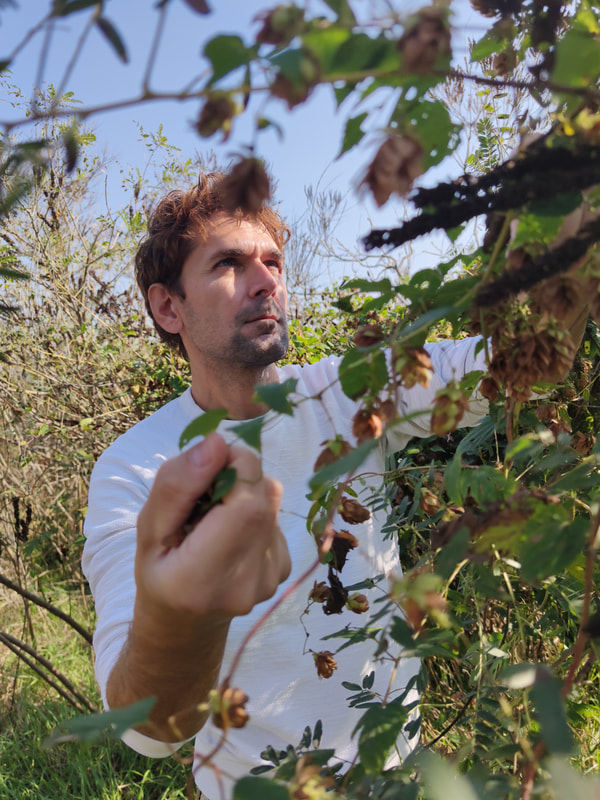
I live in an area of Italy, Piedmont, in a small town surrounded by woods and fields.
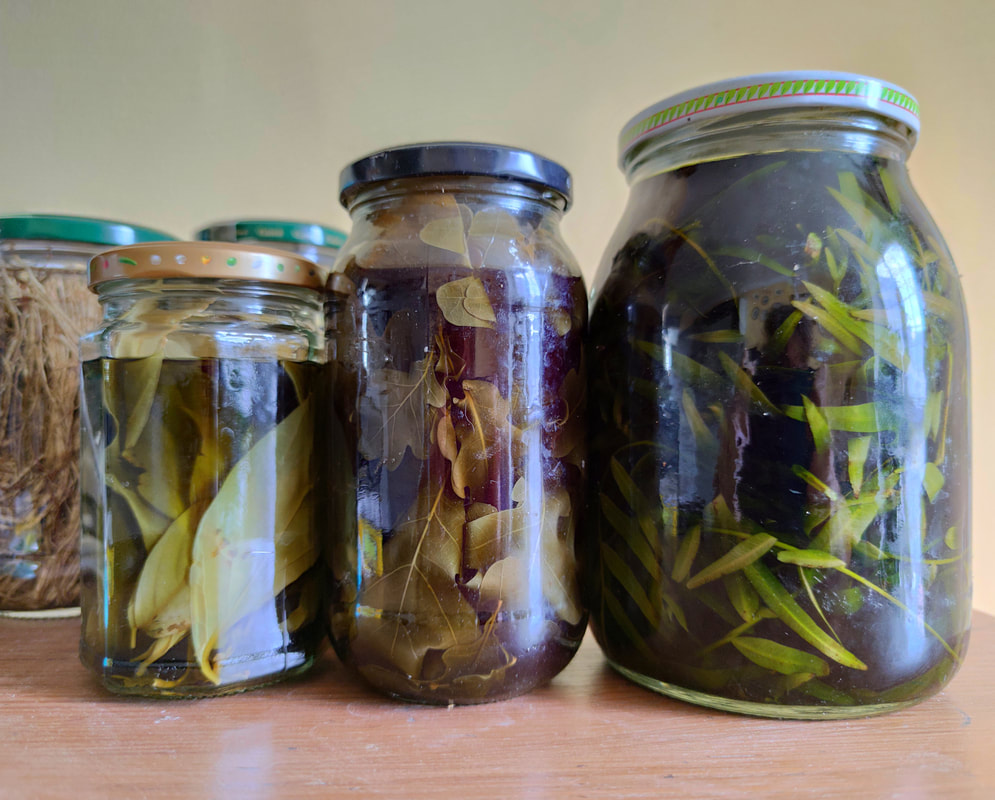
In the garden, I cultivate ornamental plants for the pure pleasure of their flowers or their leaves but also other, perfumed, to extract their fragrance: different varieties of roses, aromatic herbs, daffodils, hyacinths, chrysanthemums, lilacs, tetradenias and much more. I love the explosion of colours and scents of the garden in spring, but I also love the quiet of autumn. The garden is slowly falling asleep. These are the moments that lead me to look beyond the hedge, to return to take long walks in a bare landscape immersed in the usual fog of the area. These are moments of calm and intentional solitude in which I can contemplate the passing of the seasons. These are also times in which I start looking for seasonal fruits and berries, or new plants to extract; something different, new to fill the tincture jars with.
Not all the extractions I do, I then use in perfumes. Some remain closed in their containers for some time, even years, before I can find the right use. But I often extract for the sheer pleasure of experimenting and exploring.
Autumn is the season of mushrooms that can be used to expand our palette of essences.
Think of their damp mossy smell, of undergrowth, of fallen leaves wet from the rain. Think about how nicely these nuances can expand those of the woods and barks. Different varieties are used in cooking or cosmetics that we can use too. Porcini, chanterelles, field mushrooms, honey mushrooms and many more. Each with their olfactory peculiarity.

I discovered chanterelles by chance. Their orange colour stands out on the ground, single or in clusters camouflaged among the fallen leaves.
The characteristic that struck me is their taste and aroma that somehow recalls that of apricot with wild nuances. Mushrooms can be dried and then used in tinctures.
To my surprise, I found some woody mushrooms. Doing some research, I found out that it is the Ganoderma species. They are known for their medicinal properties. Some are easily recognizable and rather easy to find. They are lignicolous, annual or multi-annual fungi of brown, ocher, or reddish colour with a lighter underside. They are parasites and saprophytes. They can be found on both deciduous and coniferous trees.
Their scent immediately refers to that of mushrooms in general but once dried it takes on a darker, richer woody profile. Sliced when still fresh and left to dry in the air for a few days, they can be used in tinctures.
How could we forget about the truffles? They constitute a precious and sought-after food essence. Their scent, so penetrating and distinctive, develops only after ripening and to attract wild animals to spread the spores and perpetuate the species.
The truffles were already appreciated in ancient times. Aphrodisiac properties were ascribed to them. For some, their aroma, during the period of the Middle Ages and the Renaissance, contributed to the ecstatic effect on man.
Although relatively rare and expensive, truffles can add a distinctive earthy, musky, moist, somewhat nutty and dark chocolatey undertone. A small amount is enough to give a new dimension to a fragrance.
The leaves, which in this period are tinged with bright colours, can represent an interesting raw material. Have you ever rubbed the nearly dry leaves of walnut or cherry in your hands? Have you ever smelled it? While walnut leaves may be difficult to work into a final composition due to their ability to dye, cherry leaves have a delicately fruity hay scent. I especially love the oak ones that I extract both in spring and autumn. The young ones have a bitter, warm, lively and intensely green scent while those at the end of their life cycle give me the sensation of wood warmed by the sun, the scent is more dense, mysterious, rich with earthy nuances.
During one of the walks, I had by chance browsed among the shrubs of Amorpha fruticosa in search of mushrooms.
I still remember today the pungent, resinous, warm, and intense smell that remained on my hands while I was trying to make my way through the shrubs. I did not immediately connect the smell to that of the plant to which I had not paid much attention before. I was very surprised when, by exclusion, I was able to link the odour to this species and after some research on toxicity I started the first extraction experiments. It is a North American plant that grows spontaneously around the house. In the past, it was used to produce dye for fabrics and ornamental purposes. With time and abandonment of cultivation, it became wild and invaded roadsides, riverbanks, and the fields. It is one of the most invasive species in Europe. Its seeds have a curious olfactory profile: herbaceous, aromatic, vaguely urinous with hints of spicy accents that remind me of the seeds of some Apiaceae. The leaves also have a characteristic scent, strongly aromatic, resinous, warm and different from that of the seeds. The same plant offers two interesting and unusual raw materials.
Among my favourite fruits, not so much for the taste, but for the smell, is the quince.
My grandmother used to put some in the closet. Their scent mixed with that of wood, bunches of lavender and fabrics, creating an intense and rich aroma. The fruit, cut into thin slices and dried, creates an acidulous, unusual, pleasantly juicy and liqueur-like tincture with green, herbaceous and vaguely floral nuances.
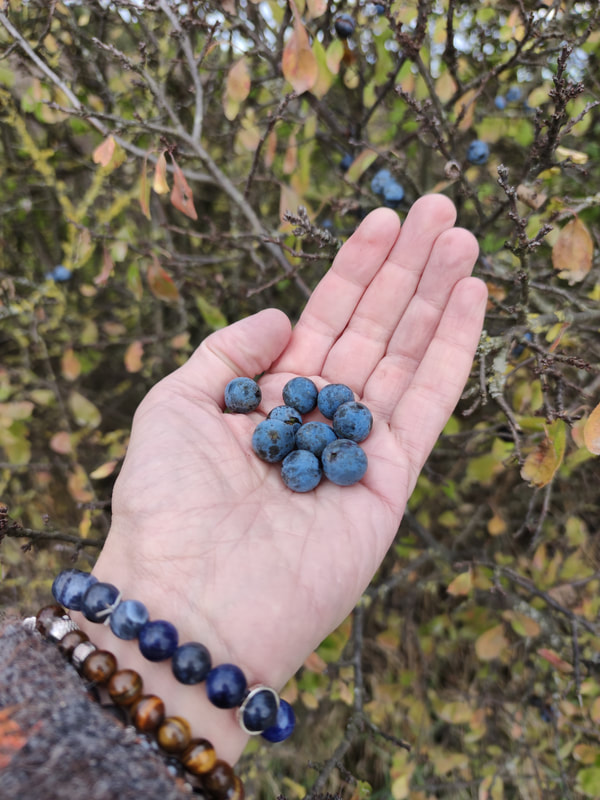
Mahonia plants are also covered in dark blueberries this season. Their sour taste is reminiscent of that of unripe grapes. The fruits, berries with a floury consistency, can be easily dried. I use them to create a sour-scented, wild berry tincture that adds a pleasant fruity hue to the rose.
 |
 |
Think of what nature offers around you in this period: pumpkins, berries, roots, tree bark covered with moss, lichen, mushrooms, seeds, pine cones covered with resin, leaves and flowers.
Sniff them, taste them, rub them in your hands. Do you smell them?
Can you imagine it in a fragrance? Sometimes you just need to look around.
Autumn is a magical season for this too: nature is preparing to conclude a cycle, to fall asleep until spring, but for us, it may be the right time to awaken our sense of smell. Let us be guided by the nose to discover new smells around us.
Follow a Natural Olfaction Training Course or a Raw Material Extraction Method Course with Pr. Andrej Babicky